
The event commenced with the news that the Yucatán government is focused on wellness tourism. Lic. Darío Ocampo, Secretary of Tourism for Yucatán, highlighted that the state of Yucatán can offer travellers experiences rich in nature, culture and hospitality. Wellness tourism improves the skills, knowledge, and opportunities for the people of Yucatán.

The Mayan Worldview as a Model for Holistic Well-Being: Opportunities for Wellness Tourism
Dr. Margarita de Abril Navarro Favela, Dra. Margarita opened with a greeting spoken in Maya, explaining that in the Mayan culture, health is understood as a state of balance, with illness arising when the equilibrium between opposing forces – such as cold and heat – is disrupted. Temperature serves not only as a physical sensation but also as a cultural and metaphorical framework for regulating emotions, control, and reproduction. Central to this view of wellness are the concepts of the physical heart (puksi’ik’al) and the spiritual heart (óol), the latter representing the vital force or willpower that governs a person’s actions, emotional health, and physical capability to perform daily work.
Dra. Margarita highlighted opportunities for wellness tourism such as interaction with nature like beekeeping and learning the legends of the medicinal plants of the jungle, astrotourism from rural areas with no light pollution, cave diving in cenotes, birdwatching, participation in cultural ceremonies.
The Incredible Wellness Real Estate Industry: The Keys to a Successful Project
Alejandro Leo, CWO, ALEC Wellness Consulting
 Wellness Real Estate is a global industry movement focused on designing, constructing, and operating properties that proactively support the physical, mental, and social health of their occupants. Unlike traditional sustainable building, which prioritizes environmental efficiency and energy conservation, wellness real estate places human health at the center of the built environment by integrating features like purified indoor air and water, circadian lighting, biophilic architecture, non-toxic materials, and active living spaces. As it shifts from an exclusive luxury amenity to an essential component of a healthy lifestyle, the sector faces a rapidly growing market where buyer demand for health-optimized homes continues to outpace available supply.
Wellness Real Estate drives profitability while enhancing health. Mid-to-high-end residential properties achieve 10-25% price premiums, while commercial assets gain 4.4-7.7% higher rent per square foot. Benefits include faster sales, longer leases, lower tenant turnover, and boosted workplace productivity, retention, and reduced absenteeism.
Wellness Tourism: Growth Opportunities and Smart Management of the Sector
Eduardo Finci, President, American Spa Association / American Wellness Association
Eduardo spoke of the opportunities in Mexico for wellness tourism, sitting at 15th in the global ranking for wellness tourism, and with lower than average rates of wellness tourism expenditure, there is huge potential in this market.
Latin American wellness tourism succeeds by differentiating rather than copying, building a connected ecosystem instead of isolated offerings. It relies on four key pillars: local identity, nature, community engagement, and high-quality integrated hospitality services.
 The Global Wellness Institute (GWI) provides six recommendations to align tourism with local quality of life: expanding public infrastructure, integrating local community economies, supporting the workforce’s health, ensuring equitable and sustainable resource management, using evidence-based regulation, and deploying purposeful technology to promote digital well-being.
Eduardo highlighted the World Wellness Weekend and how getting involved in bringing wellness activities to local communities can also result in exposure and help to attract wellness tourists.
Wellness Cluster – Maldonado: A Successful Public-Private Partnership
Enrique Leivas, Director, Punta del Este Wellness Lifestyle Cluster
Enrique outlined the process behind the formation of the Cluster Wellness Punta Del Este, Uruguay, where the sectors of academia, business, and government united to create a council focused on wellness tourism.
The wellness industry is a key driver for regional development; it transforms local economies, physical spaces, and social dynamics by revaluing local resources. The two main benefits are the diversification of the productive matrix, which allows traditionally agricultural or industrial areas to shift toward high-value service economies like spas, retirement centers, and ecotourism; and investment attraction, which brings in capital for hotel infrastructure, comprehensive health centers, and spas, thereby generating direct and indirect jobs while helping reduce seasonality.
7 key concepts:
・Separate and balance governance and leadership
・Identify, contextualize, conceptualize
・Define an objective function matrix
・Establish objectives, principles, and values
・Seek consensus on an ongoing basis
・Build within a transdisciplinary, inter-institutional, and multisectoral framework
・Promote a culture of collaborative production
From Ritual to Revenue Management: The Perfect Combination, a Spa with a Profitable Soul
Carmelina Montelongo, CEO, Sisi Studio
Carmelina explained that human existence is defined by a constant duality, a delicate balance between emotion and reason, the heart and the mind. Navigating the journey between these two forces is often described as the longest path a person can travel, yet achieving coherence between them is essential. Ultimately, true wellness requires uniting the magic of emotion to create value with the precision of metrics to sustain it.
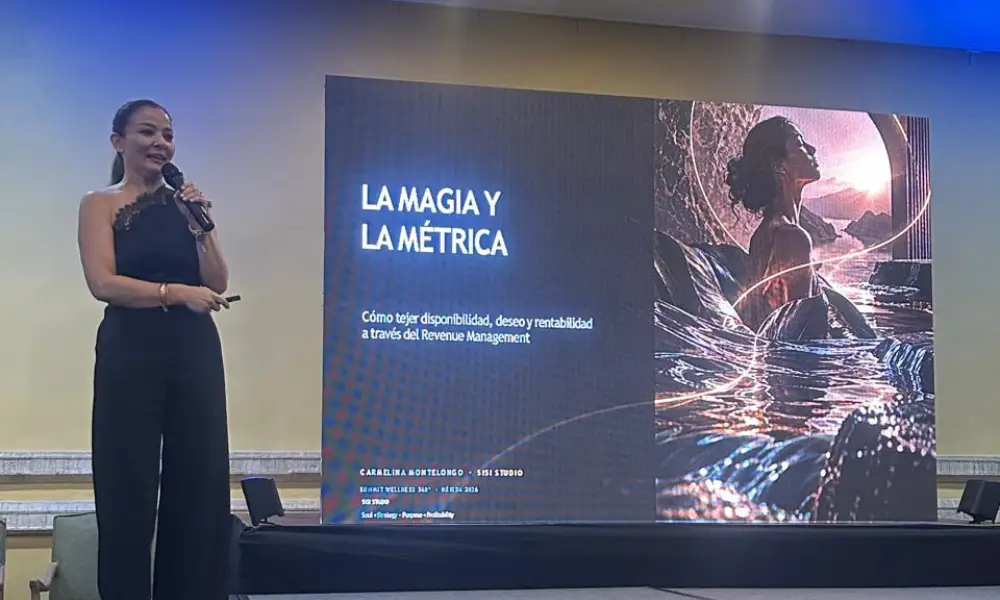 When brand coherence is achieved through smooth, invisible transitions between what is promised and what is delivered, a customer’s expectation seamlessly transforms into a lasting emotional connection. Behind this visible journey – from initial expectation (Promise) to actual experience (Delivery) and ongoing impression (Permanence) – lies an invisible framework driven by organizational structure, continuous metric evaluation, and sustainable practices. Supported by an underlying alignment of soul, strategy, purpose, and profitability, this seamless structure eliminates contradictions, allowing the brand experience to flow naturally until it creates a genuine, transformational movement within the customer – turning operational coherence into true magic.
Revenue Management is essential for spa and wellness businesses, where empty treatment room hours cannot be resold tomorrow, alongside fixed constraints like limited cabin capacity and therapist availability. Because demand fluctuates significantly between peak weekend times and off-peak hours, advance bookings require simultaneous management of time, treatment rooms, and specialized therapist skill sets. Consequently, businesses can maximize revenue by leveraging dynamic pricing – offering off-peak incentives and charging premium rates during peak demand – while catering to varying customer price sensitivities, balancing those who value specific time slots against those seeking lower rates through flexible scheduling.
Wellness Vision: Perspectives and Trends for the Future of Wellness
Sara Jones, Editor and Managing Director, Spa & Wellness MexiCaribe
 The global wellness economy is valued at $6.8 trillion in 2024 and projected to reach $9.8 trillion by 2029, with Latin America already commanding $141.2 billion – with Brazil leading and Mexico in second place. Sara shared that converting this growth into real value requires elevating wellness from an optional service to an indispensable asset, prioritizing high-value guests and transforming forgettable treatments into continuous, loyalty-building rituals.
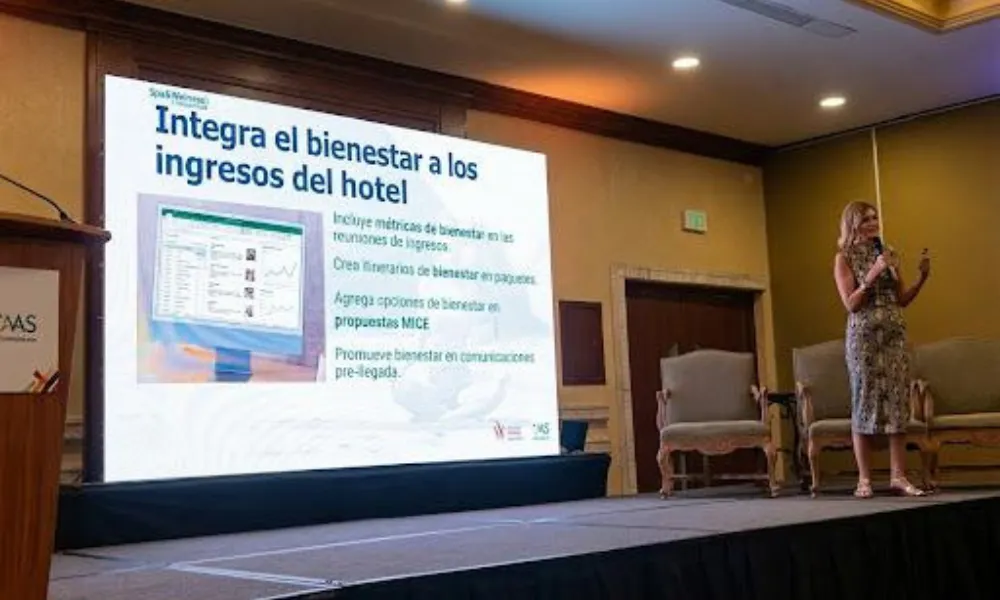 Analyzing what today’s well-informed consumer seeks, she traced the rise of longevity protocols, female longevity and menopause programming, social and festivalized wellness, competitive fitness travel, and AI-driven personalization with real-time booking. She also highlighted the industry’s defining challenges – microplastics, extreme heat and coolcationing, and the urgent professionalization of a fast-growing sector – and a decisive shift from optimization toward neurowellness, human-centered care, and regenerative models that restore guest, community, and planet alike.
Standards That Elevate: The Importance of Certifications Based on International Wellness Standards
Jessica Heredia, CEO and Founder, Consciencia Wellness
Wellness and well-being are fundamentally distinct, as true wellness extends beyond short-lived moments of relaxation or leisure to serve as the underlying system that enables lasting well-being over time. Defined as the intentional practices and structures designed to develop people’s full potential, wellness creates the supportive organizational conditions necessary to produce real, sustainable outcomes rather than isolated instances of comfort. When this structured approach is fully integrated into how an organization operates, it transforms from a simple strategy into a true ‘Wellness Culture.’
Distinct pillars of the industry are driven by the collaboration of three key actors: Academia provides the research, evidence, and methodological rigor that validate standards globally; Major hospitality brands demonstrate large-scale adoption while proving that internal organizational culture can match the quality of customer experience offered; and Entrepreneurs drive ethical innovation, introducing novel solutions built upon a shared, common foundation rather than working in isolation.
www.asociacionspa.com.ar/summit-wellness-360/2026/merida
By Sara Jones, Editor